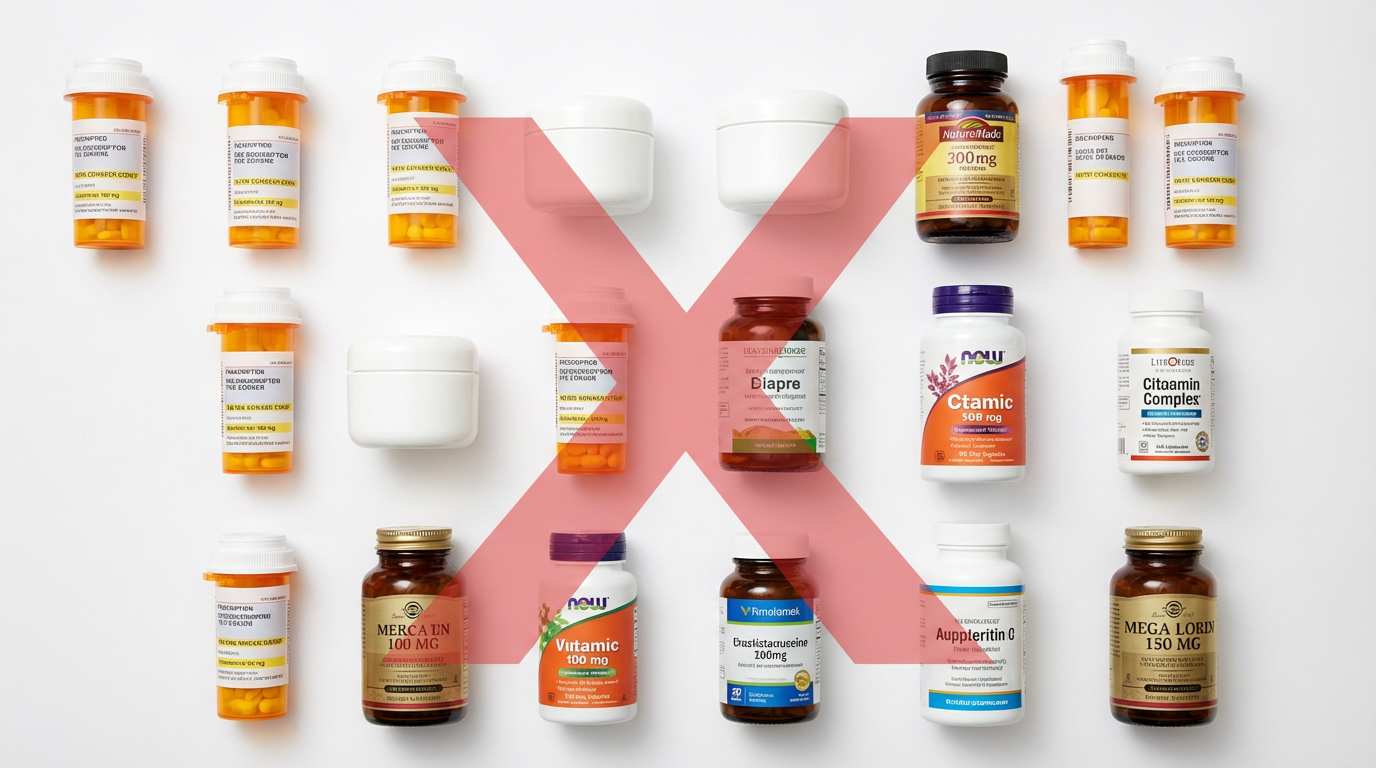
After decades of research and clinical observation, I've concluded that lasting relief from neuropathy requires three things.
Not one.
Not two.
All three.
Requirement 1: Calm the Misfiring
Your nerves are hyperexcitable. They fire when they shouldn't. They send pain signals when there's no injury.
This is why you feel the burning at night, the tingling that won't stop, the pins and needles that wake you up at 3am...
B6 plays a direct role in synthesizing the neurotransmitters that regulate nerve signal activity. Without adequate B6, your nervous system has no reliable mechanism to tell overactive nerves to settle down.
But this is only part of the calming picture.
A targeted herbal complex, Passion Flower, Skullcap Root, and Oat Straw, has been used for centuries specifically for nerve hyperactivity. Not to sedate your entire central nervous system the way Gabapentin does...
But to calm the specific overactive nerve signaling that creates the burning and tingling you feel every day.
Gabapentin tries to solve this by suppressing your entire brain. It's like cutting the power to your whole house because one light won't turn off.
The right targeted nutrients address it at the source, without touching the rest of your nervous system.
Requirement 2: Repair the Damage
Here's what most treatments get completely wrong: they focus only on symptoms.
Calming the misfiring brings relief.
But after months or years of nerve hyperactivity and oxidative stress, your nerves have sustained real structural damage. The myelin sheath has deteriorated and nerve tissue has accumulated oxidative damage.
If you only calm the misfiring without supporting repair, you're managing a worsening condition, not improving it.
This is where three specific ingredients become critical.
Methylcobalamin is the active form of Vitamin B12. It goes directly to work supporting myelin synthesis, the rebuilding of the protective insulation your nerve fibers need to function and heal.
Hundreds of studies confirm that Methylcobalamin specifically supports nerve regeneration in neuropathy patients, regardless of whether a deficiency is present.
Benfotiamine is a specialized fat-soluble form of Vitamin B1, developed specifically for nerve tissue repair. Clinical trials on neuropathy use it at a full 600mg. Not the trace amounts in a standard B complex, a full therapeutic dose targeted specifically at nerve tissue.
Stabilized R-Alpha Lipoic Acid is the biologically active form of ALA. It works continuously against the oxidative damage that accelerates nerve deterioration. Because only the R form is active in nerve tissue, the stabilized R version delivers meaningfully more benefit than the racemic form most supplements use.
Think of it this way: the calming complex settles the misfiring. Methylcobalamin, Benfotiamine, and R-ALA rebuild what the damage has done and protect what remains.
Gabapentin does neither. It just keeps you too sedated to notice things are still getting worse.
Requirement 3: Get Inside the Nerve Cell
This is where almost every B vitamin supplement fails completely. And it's the thing almost nobody explains.
Your nerve cell membranes are fatty by design. That fatty structure is what allows electrical signals to travel properly along the myelin sheath. But it also creates a wall.
Standard B vitamins are water-soluble. And water-soluble compounds cannot cross a fatty membrane. It doesn't matter how much is in your bloodstream, or how well your labs look on paper, if it can't get inside the nerve cell itself.
This is the reason patients can take B12 for years, test at perfectly normal levels, and still experience worsening neuropathy symptoms.
The nutrient is circulating. It's just not getting in.
Benfotiamine's fat-soluble structure is what makes it uniquely effective here. Because it can cross nerve cell membranes that water-soluble thiamine never can, it actually reaches the cells that need it.
That's why the dose and form matter. A water-soluble B1 at any dose still can't get through the membrane.
Methylcobalamin solves it a different way. By skipping the two-step conversion that cyanocobalamin requires, it stays intact and bioavailable long enough to actually reach peripheral nerve tissue in the feet and hands.
These aren't marginal upgrades, they're the difference between a nutrient that circulates uselessly and one that gets where it needs to go.
For years, I told patients there was no perfect solution. The best we could do was layer multiple approaches and hope for cumulative effect.
Then I found something that changed that entirely.